

At Delishi Hydraulic Machinery, we design and manufacture hydraulic presses according to the actual requirements of each production process. From selecting the right tonnage to integrating automation and safety systems, our engineering team develops hydraulic press solutions around your products, materials, tooling, and production goals.
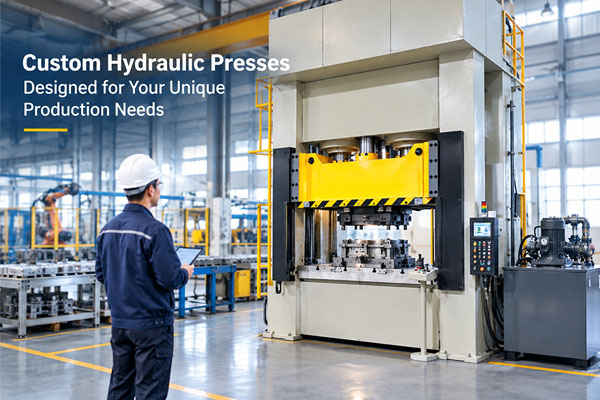
Why Choose a Custom Hydraulic Press?
A hydraulic press is more than a machine that applies force. Its structure, hydraulic system, control technology, tooling, and automation all affect production performance.
A standard press may work well for general applications, but your process may require:
• A specific pressing force or tonnage
• Customized table dimensions
• Extra-long or adjustable stroke
• Special working height
• Controlled pressing speed
• High positioning accuracy
• Multi-step forming cycles
• Automatic loading and unloading
• Integration with production lines
• Special tooling or die arrangements
• Custom safety and control systems
Instead of changing your production process to fit a standard machine, a custom hydraulic press allows the machine to be designed around your process.
From Production Requirements to Machine Design
Every custom hydraulic press project starts with understanding the application.
Our engineers evaluate key production parameters such as material type, part dimensions, forming method, required force, cycle time, tooling, and expected production volume. These factors help determine the appropriate press structure and hydraulic configuration.
1. Define the Pressing Requirements
The first step is determining how much force your application requires. Depending on the process, the machine may be designed for light-duty pressing, precision forming, deep drawing, cold forging, hot forging, or heavy industrial applications.
Press capacity can be customized according to the required production force and forming conditions.
2. Design the Working Area
The working table and daylight directly affect tooling installation and product size.
For applications involving large components or complex dies, we can customize:
• Table length and width
• Working height
• Daylight opening
• Slide dimensions
• T-slot configuration
• Die mounting arrangements
This helps ensure that your existing or newly designed tooling can be properly installed and operated.
3. Customize Stroke and Speed
Different manufacturing processes require different motion profiles.
A deep drawing operation may require a longer stroke and carefully controlled forming speed. A cold forging application may require high force and precise movement. A general pressing application may prioritize cycle speed and productivity.
Custom hydraulic presses can be configured with suitable stroke, approach speed, working speed, return speed, and pressure control according to the process.
Hydraulic and Servo Technology for Better Process Control
The hydraulic system is at the heart of press performance.
Depending on your application, a custom press can incorporate advanced hydraulic components and servo-driven systems to improve control over pressure, speed, position, and cycle operation.
Servo hydraulic technology can provide more precise control while helping reduce unnecessary energy consumption during machine operation. It is particularly useful for production processes where motion profiles and repeatability are important.
For demanding applications, the control system can also support programmable pressing parameters and multi-stage forming sequences.
Automation Designed Around Your Production Line
A custom hydraulic press does not have to operate as a standalone machine.
For automated manufacturing, the press can be integrated with equipment such as:
• Automatic loading systems
• Robotic arms
• Transfer systems
• Conveyor systems
• Automatic feeding equipment
• Vision inspection systems
• Part unloading systems
• Die changing systems
• Production data monitoring
The automation configuration is developed according to the customer's production workflow.
For example, a robotic system can load raw material into the press, transfer formed parts between processes, and remove finished components automatically. This can help reduce manual handling and create a more consistent production cycle.
Custom Hydraulic Presses for Different Applications
Different industries have different forming requirements. A properly engineered custom press can be adapted to a wide range of manufacturing processes.
Metal Forming and Sheet Metal
Custom hydraulic presses can be used for bending, forming, punching, straightening, stamping, and other metalworking processes.
Deep Drawing
Deep drawing applications often require carefully controlled pressure and movement. Press dimensions, stroke, blank-holder systems, and hydraulic control can be configured according to the product geometry.
Cold Forging
Cold forging requires high forming forces and a rigid machine structure. Custom press design can address the required tonnage, tooling arrangement, stroke, and production cycle.
Hot Forging
For hot forging applications, the press must be designed to withstand demanding operating conditions. Machine structure, hydraulic capacity, cooling, tooling, and automation can all be considered during the engineering stage.
Composite and Plastic Forming
Hydraulic presses are also widely used for compression molding and forming composite, rubber, and plastic materials. Temperature control, pressure holding, and customized tooling interfaces can be incorporated into the machine design.
Straightening and Assembly
For shaft straightening, component assembly, bearing installation, and similar applications, the press can be configured for precise force and position control.
Customization Beyond Tonnage
Many buyers think customization simply means choosing a different press capacity. In reality, a custom hydraulic press can be tailored across the entire machine.
Customization may include:
Machine structure:
Frame design, column configuration, working table, slide, daylight, and overall dimensions.
Hydraulic system:
Pump configuration, valves, cylinders, pressure control, cooling, and filtration.
Control system:
PLC control, HMI interface, programmable cycles, position control, pressure monitoring, and production data.
Tooling interface:
Die mounting, T-slots, ejector systems, cushions, and customized tooling arrangements.
Automation:
Robots, feeders, conveyors, sensors, vision systems, and automatic part handling.
Safety:
Light curtains, safety doors, emergency stops, interlocks, and other protection systems according to the machine configuration and applicable requirements.
This comprehensive approach allows the hydraulic press to become part of your manufacturing system rather than simply another piece of equipment.
Why Engineering Experience Matters
Custom machinery requires more than manufacturing capability. It requires the ability to translate production requirements into a reliable machine design.
An experienced hydraulic press manufacturer should be able to evaluate the complete application, identify potential limitations, and recommend a suitable combination of mechanical structure, hydraulic technology, control systems, tooling, and automation.
At Delishi Hydraulic Machinery, our custom press projects are developed through communication between the customer and our engineering team. Production requirements are reviewed before the machine configuration is finalized.
This approach helps reduce unnecessary customization while ensuring that critical requirements are addressed from the beginning.
Built for Your Production, Not a Generic Application
The right hydraulic press should match your production process.
Whether you need a compact custom press for precision assembly or a large-capacity machine for heavy forming and forging, the design should reflect the actual requirements of your application.
A custom hydraulic press can help manufacturers achieve:
• Better process control
• More consistent forming results
• Improved production flexibility
• Easier automation integration
• Optimized machine dimensions
• Reduced manual operations
• Higher production efficiency
A machine configuration tailored to the product
Talk to a Hydraulic Press Manufacturer About Your Application
Choosing a custom hydraulic press starts with the right technical information.
When requesting a quotation, providing details such as required tonnage, product dimensions, material, tooling, stroke, cycle time, production volume, automation requirements, and available installation space can help engineers develop a more accurate solution.
At Delishi Hydraulic Machinery, we work with manufacturers to develop hydraulic press machines around their specific production needs. From machine structure and hydraulic systems to servo control and automation, each solution can be engineered according to the application.
Have a unique pressing or forming requirement? Tell us what you need to manufacture, and our engineering team can help develop a custom hydraulic press solution for your production line.
 +86-13509801050
 E-mail
