

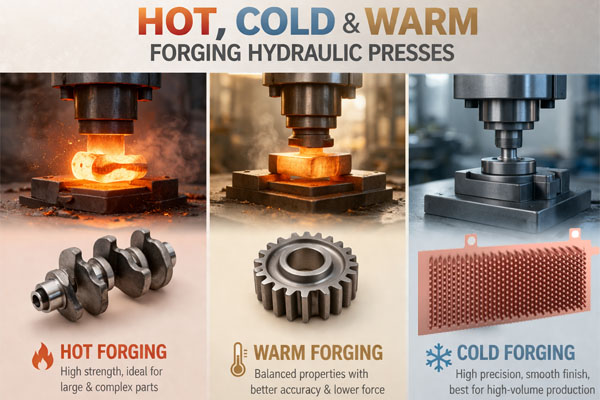
Selecting the right forging process is essential for achieving the best results in strength, precision, and production efficiency. Whether you are manufacturing automotive parts, industrial components, or precision hardware, understanding the differences between hot, cold, and warm forging hydraulic presses will help you make a smarter decision.
Many manufacturers struggle to determine which forging hydraulic press aligns with their production goals, material specifications, and end-product requirements. This comprehensive guide breaks down the key differences between hot, cold, and warm forging hydraulic presses, their unique advantages, ideal applications, and critical selection criteria to help you make a confident, data-driven purchasing decision.
What Is a Forging Hydraulic Press?
A forging hydraulic press uses high-pressure hydraulic force to shape metal into specific forms. Compared to mechanical presses, it offers:
● Precise control over force and speed
● Consistent product quality
● Flexibility for different materials and shapes
● Ability to handle complex forging processes
The main difference between forging types comes down to temperature, which directly affects how metal behaves during forming.
Hot Forging Hydraulic Press
What Is Hot Forging?
Hot forging is performed at high temperatures, usually above the metal’s recrystallization point. This makes the material softer and easier to shape.
Key Benefits
● Ideal for large and complex components
● Reduces forming force requirements
● Improves internal grain structure and strength
● Suitable for hard materials like steel alloys
Limitations
● Lower dimensional accuracy
● Surface oxidation (scale) may occur
● Often requires additional machining
Typical Applications
● Crankshafts and axles
● Heavy-duty machinery parts
● Construction and mining equipment
Best For
Choose hot forging when your priority is strength, durability, and forming complex or large parts.
Cold Forging Hydraulic Press
What Is Cold Forging?
Cold forging is done at or near room temperature without heating the material.
Key Benefits
● Excellent dimensional accuracy
● Smooth surface finish
● No oxidation or scale
● High material utilization (less waste)
Limitations
● Requires higher press force
● Limited to simpler shapes
● Only suitable for ductile materials
Typical Applications
● Bolts, nuts, and fasteners
● Small precision components
● Electronic and hardware parts
Best For
Choose cold forging when you need high precision, high volume, and minimal post-processing.
Warm Forging Hydraulic Press
What Is Warm Forging?
Warm forging operates at intermediate temperatures, typically between 500°C and 900°C. It combines the advantages of both hot and cold forging.
Key Benefits
● Better accuracy than hot forging
● Lower force than cold forging
● Improved material flow
● Reduced oxidation compared to hot forging
Limitations
Requires precise temperature control
Higher operational complexity
May still need light finishing
Typical Applications
● Gears and transmission parts
● Automotive components
● Medium-complexity metal parts
Best For
Choose warm forging when you want a balance between precision, strength, and efficiency.
Key Factors to Consider
1. Material Type
● Hard or high-strength alloys → Hot forging
● Soft, ductile metals → Cold forging
● Medium-strength materials → Warm forging
2. Part Complexity
● Complex shapes → Hot forging
● Simple, high-precision parts → Cold forging
● Medium complexity → Warm forging
3. Production Volume
● Mass production → Cold forging
● Medium to high volume → Warm forging
● Lower volume or large parts → Hot forging
4. Cost Considerations
● Cold forging reduces machining costs
● Hot forging lowers forming force but increases finishing needs
● Warm forging offers a balanced cost-performance ratio
5. Surface Finish & Accuracy
● Best: Cold forging
● Moderate: Warm forging
● Lowest: Hot forging
Quick Comparison
|
Feature
|
Hot Forging | Warm Forging | Cold Forging |
| Temperature | High | Medium | Room Temperature |
| Accuracy | Low | Medium | High |
| Surface Finish | Rough | Good | Excellent |
| Forming Force | Low | Medium | High |
| Complexity | High | Medium | Low–Medium |
| Production Volume | Medium | Medium–High | High |
Final Thoughts
There is no single“best”forging method—only the one that best fits your needs.
● Hot forging is ideal for large, strong, and complex parts
● Cold forging is perfect for precision and mass production
● Warm forging offers a practical balance between the two
In many cases, manufacturers combine different forging methods to optimize both cost and performance.
Need Help Choosing the Right Hydraulic Press?
If you're planning to invest in a forging hydraulic press, it's important to evaluate:
● Material specifications
● Product design
● Production capacity
● Budget and long-term ROI
Working with an experienced supplier can help you select the most efficient and cost-effective solution for your business.
 +86-13509801050
 E-mail
