

Hot Forging vs. Cold Forging – Which Hydraulic Press Process Wins for Your Application?
Temperature · Precision · Material Suitability · Cost · Energy Efficiency
When it comes to forging with hydraulic presses, one of the most critical decisions you'll make is whether to use hot forging or cold forging. Both processes have distinct advantages, but the right choice depends on your material, part geometry, production volume, quality requirements, and budget.
In this guide, we break down the key differences, advantages, and limitations of each process — so you can make an informed decision that maximizes quality, efficiency, and profitability.
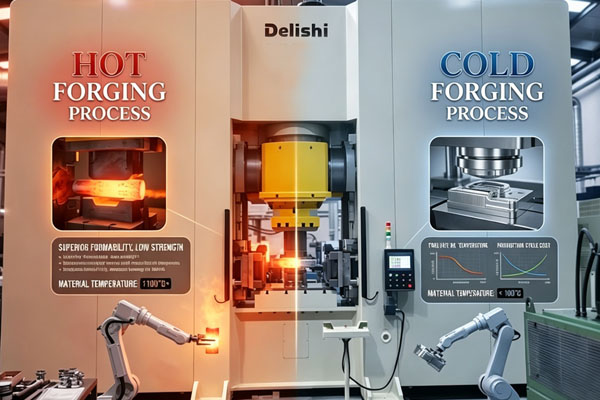
Hot Forging vs. Cold Forging – Side-by-Side Comparison
| Factor | Hot Forging | Cold Forging |
|---|---|---|
| Temperature | Above recrystallization point (typically 950°C – 1250°C) | Room temperature or slightly elevated (up to ~200°C) |
| Material Suitability | High-strength steels, titanium, nickel alloys, aluminum, copper | Aluminum, copper, medium-carbon steels, stainless steels |
| Dimensional Accuracy | Moderate (±0.5 – 1.0 mm) | Excellent (±0.01 – 0.05 mm) ✓ |
| Surface Finish | Rough; requires post-machining | Smooth; often net-shape ✓ |
| Part Complexity | High – complex shapes possible ✓ | Moderate – simpler geometries |
| Energy Consumption | High (heating + press power) | Lower (no heating) ✓ |
| Tooling Cost | Lower (materials don't need extreme wear resistance) | Higher (tools must withstand high stress) |
| Material Waste | Higher (oxidation, scale, machining allowance) | Lower (near-net shape) ✓ |
| Production Speed | Slower (heating time + multiple strokes) | Faster (single or fewer strokes) ✓ |
| Grain Structure | Refined; improves toughness | Work-hardened; increases strength but reduces ductility |
| Post-Processing | Machining, heat treatment often required | Minimal or none ✓ |
| Typical Part Size | Large to very large ✓ | Small to medium |
✓ = Advantage in this category
Hot Forging – High-Temperature Forming for Complex Parts
Hot forging involves heating metal above its recrystallization temperature — typically between 950°C and 1250°C for steel — before applying hydraulic press force. At these temperatures, the metal becomes highly malleable, allowing for significant deformation with lower press tonnage.
• Automotive crankshafts, connecting rods, and axle beams
• Aerospace landing gear and turbine discs
• Heavy machinery gears and shafts
• Large flanges, valves, and pipe fittings
• Forging high-strength alloys like titanium and nickel-based superalloys
Advantages of Hot Forging
- Complex geometries – Allows forming of intricate shapes that would be impossible in cold forging.
- Lower press force required – Heated metal deforms more easily, reducing tonnage needs.
- Superior grain structure – Recrystallization refines grain size, enhancing toughness and fatigue resistance.
- Material versatility – Works with a wide range of metals, including high-strength and heat-resistant alloys.
- Large part capability – Ideal for big components that cannot be cold-formed.
Limitations of Hot Forging
- Lower dimensional precision – Thermal expansion and scaling reduce accuracy.
- Rough surface finish – Oxidation and scale formation require post-machining.
- High energy costs – Heating furnaces consume significant energy.
- Slower cycle times – Heating and cooling add to production time.
- Material waste – Scale loss and machining allowances increase waste.
Cold Forging – Precision, Efficiency, and Net-Shape Production
Cold forging is performed at or near room temperature (often up to 200°C for warm forging variants). The metal is formed by hydraulic press force alone, without external heating. This process is widely used for small to medium-sized parts requiring high dimensional accuracy and excellent surface finish.
• Automotive fasteners, bolts, and wheel hubs
• Bearing rings and raceways
• Aluminum pistons and connecting rods
• Electrical connectors and terminals
• Transmission components and gears (for smaller sizes)
Advantages of Cold Forging
- Excellent dimensional accuracy – Achieves ±0.01mm precision; often net-shape or near-net-shape.
- Superior surface finish – Smooth surfaces reduce or eliminate machining.
- High production speed – Fast cycle times with no heating step.
- Energy efficiency – No furnace energy; lower overall operating costs.
- Minimal material waste – Near-net shape reduces scrap and material costs.
- Work hardening – Increases tensile strength and hardness of the finished part.
Limitations of Cold Forging
- Limited part complexity – Simpler geometries compared to hot forging.
- Higher press tonnage required – Cold metal requires significantly more force.
- Higher tooling costs – Tools must withstand extreme stress and wear.
- Material restrictions – Not suitable for very high-strength or brittle alloys.
- Work hardening limits – Excessive strain can cause cracking; may require intermediate annealing.
Pros and Cons at a Glance
✅ Hot Forging – Best For
- Complex, large parts
- High-strength and heat-resistant alloys
- Applications requiring enhanced toughness
- Lower initial tooling investment
❌ Hot Forging – Not Ideal For
- Applications requiring tight tolerances
- High-volume production with cost pressure
- Energy-conscious operations
- Parts requiring excellent surface finish
✅ Cold Forging – Best For
- High precision and net-shape requirements
- Small to medium parts in high volume
- Energy-efficient operations
- Minimal post-machining desired
- Aluminum, copper, and medium-carbon steels
❌ Cold Forging – Not Ideal For
- Very large or complex parts
- High-strength or brittle alloys
- Applications requiring extreme toughness
- Low-volume production with high tooling costs
How to Choose – A Simple Decision Framework
Ask yourself these questions to determine whether hot forging or cold forging is right for your application:
Your Application Checklist
- 1. What is your part size and weight?
→ Large or heavy parts (choose hot forging)
→ Small to medium parts (choose cold forging) - 2. What material are you forming?
→ High-strength steel, titanium, nickel alloys (choose hot forging)
→ Aluminum, copper, medium-carbon steel (choose cold forging) - 3. How complex is the part geometry?
→ Intricate shapes with undercuts or deep cavities (choose hot forging)
→ Simple to moderate geometries (choose cold forging) - 4. What precision and surface finish do you need?
→ Tolerances > ±0.5mm; surface not critical (choose hot forging)
→ Tolerances < ±0.1mm; smooth finish required (choose cold forging) - 5. What is your production volume?
→ Low to medium volume (hot forging may be more cost-effective)
→ High volume (cold forging offers faster cycles and lower per-part cost) - 6. What are your energy and sustainability goals?
→ Less concern about energy consumption (hot forging is acceptable)
→ Energy efficiency is a priority (choose cold forging)
Hydraulic Press Requirements – Tonnage, Speed, and Control
Both hot and cold forging require robust hydraulic press systems, but the specifications differ:
Common to both: Advanced controls with pressure and position closed-loop feedback, energy-efficient servo drives, and predictive maintenance capabilities to maximize uptime.
The Hybrid Approach – Warm Forging
For applications that require a balance between the two extremes, warm forging (200°C – 450°C) offers a middle ground. It reduces the press tonnage needed compared to cold forging while delivering better precision than hot forging with lower energy consumption. This method is gaining popularity in automotive and aerospace applications where both accuracy and material formability are critical.
Frequently Asked Questions
Is hot forging or cold forging stronger?
Cold-forged parts are generally stronger in terms of tensile strength and hardness due to work hardening. However, hot-forged parts have superior toughness and ductility, making them better for applications involving shock loads or fatigue.
Which forging process is more cost-effective?
It depends on volume. For high-volume production, cold forging is usually more cost-effective due to faster cycles, less waste, and no heating costs. For low to medium volumes, hot forging may be cheaper because tooling costs are significantly lower.
Can hot forging achieve high precision?
With advanced hydraulic press controls and precision dies, hot forging can achieve tolerances as tight as ±0.3mm, but cold forging routinely achieves ±0.01mm. If micron-level accuracy is required, cold forging is the clear winner.
What tonnage is required for cold forging vs. hot forging?
Cold forging typically requires 2 to 5 times more tonnage than hot forging for the same part and material because the metal is not softened by heat. A 1,000-ton hot forging press might require a 3,000-ton press for the same cold forging operation.
Not Sure Which Process Is Right for You?
Our hydraulic forging press experts can help you evaluate your application, material, and production requirements — and recommend the optimal press configuration for hot, cold, or warm forging.
Talk to Our Forging Specialists →Tel +86-13509801050 · Global engineering support available
 +86-13509801050
 E-mail
