

Why leading manufacturers are switching to hydraulic warm forging presses — lower costs, longer tool life, and superior part quality
For decades, mechanical hot forging presses dominated high-volume metal forming. But a quieter revolution is underway: hydraulic warm forging. By combining precise hydraulic control with moderate temperature ranges (650°C–950°C), hydraulic warm forging presses outperform traditional mechanical hot forging in ways that aren't always obvious.
Below we uncover seven hidden advantages that directly impact your bottom line, your energy bills, and your production flexibility. If you are evaluating a new forging press for steel, aluminum or alloy components, read on — the numbers might surprise you.
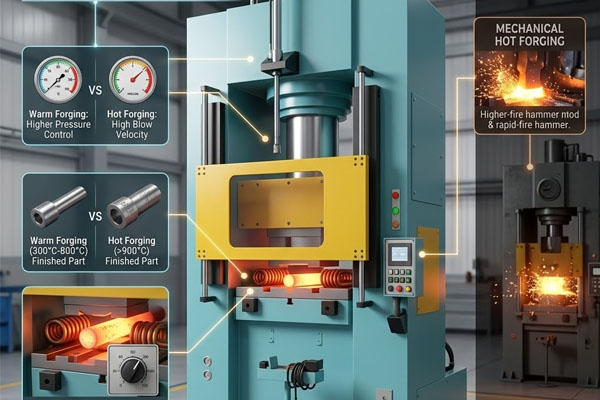
At a glance: Hydraulic warm vs. Mechanical hot forging
| Parameter | Hydraulic Warm Forging | Mechanical Hot Forging |
|---|---|---|
| Temperature range | 650 – 950°C (warm) | 1000 – 1250°C (hot) |
| Die life (typical) | 40% – 60% longer | Baseline |
| Energy consumption | 15% – 25% lower | Higher (more heat & flywheel losses) |
| Material yield | Up to +12% (less flash) | Standard yield |
| Noise level | 80 – 85 dB(A) | 95 – 105 dB(A) |
7 hidden advantages revealed
1 Dramatically longer die life – less thermal shock & smooth load
Mechanical hot forging exposes dies to intense thermal shock (from >1000°C to lubricant) and impact loading. Hydraulic warm forging operates at lower temperatures (150–300°C cooler) and uses ramp-up pressure instead of sudden impact. The result: die life increases by 40–60% on average. For high-volume components like connecting rods or gears, this alone can save tens of thousands of dollars per year in tooling costs.
2 Energy savings you can measure – up to 25% lower consumption
Heating billets to 1200°C consumes massive energy. Warm forging works at 750–950°C, cutting heating energy by roughly 15–20%. But there's more: hydraulic presses use variable-speed servo pumps and regenerate energy during decompression, whereas mechanical presses rely on heavy flywheels and clutch/brake systems that waste energy. Combined savings often exceed 20–25% per part — and with carbon footprint regulations tightening, this is both an economic and environmental win.
3 Superior dimensional accuracy & near-net shape – reduce secondary machining
Hydraulic warm forging offers full tonnage throughout the entire stroke and allows dwell time at bottom dead center. This improves material flow and reduces springback. Parts come out with tolerances as tight as ±0.1mm — often eliminating rough machining entirely. Mechanical presses, by contrast, lose force at the end of stroke and can't dwell. For automotive and aerospace components, this means shorter lead times and lower finishing costs.
4 Lower material waste – less flash & better fill
Because hydraulic presses can be precisely controlled for stroke length and speed profile, they enable closed-die forging with minimal flash. Warm forging temperatures also reduce scale formation (oxidation) by up to 50% compared to hot forging. Combined, these factors improve material yield by 8–12%. For expensive alloys (stainless steel, titanium, nickel-based superalloys), this advantage alone justifies the investment in a hydraulic warm forging press.
5 Quieter, cleaner, and safer working environment
Mechanical hot forging presses produce deafening noise – often above 100 dB(A) due to clutch engagement, gear impact, and sudden release. Hydraulic warm forging operates with smooth pump-driven motion, typically staying below 85 dB(A). Less noise reduces operator fatigue and lowers the cost of hearing protection programs. Additionally, hydraulic systems have fewer exposed moving parts (no massive flywheel, clutch, or brake dust), creating a cleaner, safer shop floor.
6 Unmatched flexibility – quick changeover & adjustable stroke
Mechanical presses are fixed-stroke machines; changing part geometry often requires expensive die height adjustments or new rams. Hydraulic warm forging presses allow infinitely adjustable stroke length, speed, and ram position via CNC controls. Need to run a tall part in the morning and a flat component in the afternoon? No problem. Changeover times drop from hours to minutes. This flexibility makes hydraulic warm forging ideal for job shops, R&D, and mixed-volume production — a hidden advantage that C-level executives love.
7 Lower total cost of ownership (TCO) over 10 years
While initial investment in a hydraulic press can be comparable to or slightly higher than a mechanical press of similar tonnage, the long-term TCO is significantly lower. Consider:
- Less downtime: hydraulic systems have fewer shock-load failures.
- Lower maintenance: no clutch, brake, or flywheel bearings to replace.
- Longer die life: as covered in advantage #1.
- Energy savings: #2.
- Reduced material costs: #4.
Real-world impact: a hydraulic warm forging success story
A tier-1 automotive supplier switched from a 2500-ton mechanical hot forging press to a servo-hydraulic warm forging press for producing constant velocity joint cages. Results after 12 months:
- ✔ Die life increased from 8,000 to 14,000 parts (+75%).
- ✔ Energy consumption dropped 23% (annual saving of $42,000).
- ✔ Flash reduced by 18%, saving 8 tons of steel per year.
- ✔ Noise level reduced from 101 dB to 83 dB.
- ✔ Annual maintenance cost halved.
The payback period? Just 14 months.
Frequently asked questions about hydraulic warm forging vs. mechanical hot forging
Is warm forging suitable for all materials?
Warm forging works excellently for carbon steels, alloy steels, stainless steels, and aluminum alloys. For very high-temperature alloys (e.g., Inconel), adjustments are possible but hot forging may still be used.
Can I retrofit my existing mechanical press to warm forging?
Usually no — hydraulic vs mechanical architecture is fundamentally different. But many manufacturers upgrade to a hydraulic warm forging press and repurpose older mechanical presses for roughing operations.
Does hydraulic warm forging require special lubrication?
Yes, but water-based graphite lubricants work well, and lower temperatures reduce smoke emissions compared to hot forging.
 +86-13509801050
 E-mail
