

So, what is the secret to extending the lifespan of industrial hydraulic presses? The answer lies in a combination of preventive maintenance, proper operation, high-quality components, and smart monitoring practices.
Why Hydraulic Press Longevity Matters
A hydraulic press is a major investment for any manufacturer. Extending its service life helps companies:
● Reduce maintenance costs
● Minimize unexpected downtime
● Improve production efficiency
● Maintain consistent product quality
● Maximize return on investment (ROI)
When properly maintained, industrial hydraulic presses can operate efficiently for decades while delivering reliable and precise performance.
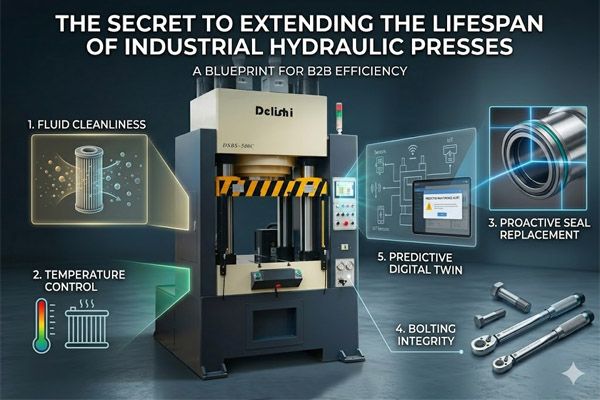
1. Fluid Cleanliness: The Lifeblood of the System
If a hydraulic press is a mechanical body, the hydraulic oil is its blood. Over 70% of all hydraulic system failures are directly linked to fluid contamination.
High pressures and tight tolerances in modern valves and pumps mean that even microscopic particles can cause catastrophic internal wear (abrasive wear).
The Longevity Strategy:
● Establish an Oil Analysis Routine: Don’t wait for the oil to turn dark or smell burnt. Implement a quarterly fluid analysis to check for particle counts, water content, and chemical degradation.
● Upgrade Your Filtration: Use high-efficiency, multi-stage filters and replace them based on pressure drop indicators, not just time elapsed.
● Keep it Sealed: Ensure all breathers and filler caps are high-quality and sealed to prevent ambient factory dust and moisture from entering the reservoir.
2. Temperature Control: Avoid the Silent Killer
Excessive heat is the enemy of hydraulic efficiency. When hydraulic oil exceeds 60°C (140°F), its viscosity drops significantly, reducing lubrication. More importantly, high temperatures accelerate the oxidation of the oil and rapidly destroy rubber seals, leading to internal and external leaks.
The Longevity Strategy:
● Monitor the Cooling System: Regularly clean air-cooled heat exchangers (radiators) of dust and debris, or check water-cooled systems for scale buildup.
● Inspect Thermostatic Valves: Ensure your cooling system kicks in exactly when it’s supposed to.
● Use the Right Viscosity: Ensure the oil grade matches your factory's ambient operating temperature.
3. The Power of Prevention: Daily Visual and Physical Checks
You don’t need an engineering degree to spot the early warning signs of hydraulic failure. Training operators to perform basic daily inspections can save tens of thousands of dollars in emergency repairs.
The Daily Checklist:
● Look for "Weeping" Seals: A minor oil weep around a cylinder rod or hose fitting today is a blown seal tomorrow.
● Listen for Cavitation: If the pump sounds like it is pumping marbles or making a high-pitched whining noise, air is trapped in the system (cavitation). This will erode metal surfaces inside the pump within hours.
● Check the Ram Alignment: Ensure the ram is traveling perfectly straight. Side-loading or misalignment puts uneven pressure on bushings and seals, causing rapid, asymmetrical wear.
4. Bolting and Structural Integrity
Hydraulic presses exert massive forces—often hundreds or thousands of tons. Over time, the constant cycling and vibration can cause structural bolts, tie rods, and component mounts to stretch or loosen.
The Longevity Strategy:
● Torque Maintenance: Establish a schedule to re-torque critical structural bolts and foundation mountings using calibrated hydraulic torque wrenches.
● Vibration Dampening: Ensure the machine is properly leveled and mounted on vibration-dampening pads to reduce structural stress on the frame.
5. Embrace the Digital Era: Predictive Maintenance
The ultimate secret to machine longevity in 2026 is moving away from preventative maintenance and adopting predictive maintenance.
Modern smart hydraulic machines utilize IoT sensors to track real-time metrics such as vibration frequencies, pressure spikes, fluid levels, and temperature fluctuations. By analyzing this data, the system can alert maintenance teams to a component failure before it actually happens.
Pro-Tip: If you are shopping for a new machine on hydraulic-machine.com, look for models equipped with smart CNC integration and digital diagnostic capabilities. Investing in a smart system today eliminates the guesswork of tomorrow.
Conclusion
There is no magical shortcut to making an industrial hydraulic press last forever. The true secret is consistency. By maintaining fluid cleanliness, controlling operational heat, empowering operators to spot early warning signs, and leveraging modern predictive technologies, you can easily double the lifespan of your machinery.
Protect your investment, eliminate unscheduled downtime, and keep your production lines moving with a disciplined approach to hydraulic care.
Manufacturers that prioritize these practices can dramatically reduce downtime, improve efficiency, and maximize the value of their hydraulic press investment for years to come.
By implementing a proactive maintenance strategy and using high-quality components, your hydraulic press can continue delivering reliable, high-performance operation in even the most demanding industrial environments.
 +86-13509801050
 E-mail
