

Whether you are working on metal stamping, bending, deep drawing, molding, or compression assembly, knowing how to calculate hydraulic press tonnage and determine the required press capacity helps you avoid equipment selection errors, extend mold service life, and maximize production efficiency. This practical, industry-verified guide will break down the standard calculation formula, key influencing factors, and application-based capacity selection rules for beginners and professional engineers.
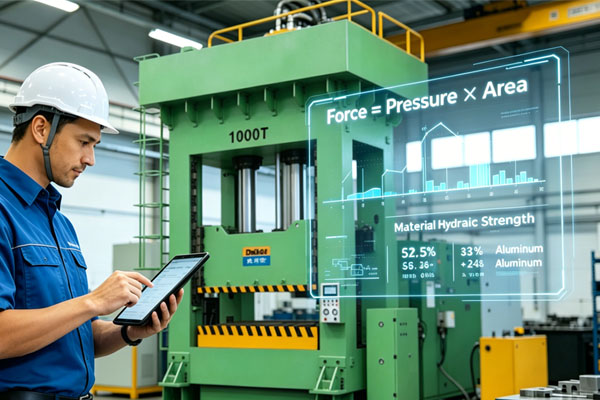
Understanding Hydraulic Press Capacity
Hydraulic press capacity, commonly expressed in tons (US tons or metric tons), refers to the maximum force the press can exert on a workpiece. One US ton equals 2,000 pounds of force. A 100‑ton press can therefore generate 200,000 pounds of downward force.
Unlike mechanical presses, which deliver peak force only near the bottom of the stroke, hydraulic presses provide full rated tonnage throughout the entire stroke. This characteristic makes them ideal for deep drawing, long‑stroke forming, and applications requiring controlled force at any position.
However, capacity is not the only specification. Stroke length, bed size, daylight opening, and speed also matter. But capacity comes first — because without enough force, no other feature matters.
Key Factors That Determine the Capacity You Need
To choose the right capacity, evaluate your application across five dimensions.
1. Material Type and Strength
Different materials require different amounts of force to form, cut, or shape. The critical property is tensile strength (for bending and forming) or shear strength (for punching and blanking).
2. Workpiece Geometry and Dimensions
● Thickness — Doubling material thickness roughly doubles the required tonnage for bending, and quadruples it for punching.
● Width or diameter — Wider parts require more force to form across the entire surface.
● Shape complexity — Deep draws, sharp corners, and multiple bends increase force demand.
3. Operation Type
Each operation has a distinct force profile:
| Operation | Force Characteristics | Typical Tonnage Range |
| Punching / Blanking | Peak force at fracture point; lower after breakthrough | 10 – 200 tons |
| Bending | Steady force; depends on die opening and material thickness | 20 – 300 tons |
| Deep Drawing | Highest during initial draw; requires sustained force | 50 – 1,000+ tons |
| Straightening | Progressive force to correct deflection | 10 – 150 tons |
| Swaging / Flattening | High force over small area | 100 – 500 tons |
Never specify a press for the exact calculated tonnage. Industry best practice is to add a safety factor of 20% to 30% for normal operations, and 50% to 100% for shock‑loading or high‑cycle applications.
Example: If your operation calculates to 80 tons, specify a 100‑ton press (25% safety margin). This protects against material variations, tool wear, and unexpected overloads.
5. Production Volume and Duty Cycle
High‑volume production (thousands of strokes per day) requires a press with a robust frame, larger cylinder, and cooling capacity. A press run near its rated limit continuously will wear faster. For continuous heavy duty, consider a press rated at 1.5× your calculated need.
How to Calculate Required Capacity by Application
While a full tonnage calculation is covered in our companion guide, here are simplified methods for common operations.
For Punching Holes
Tons = Perimeter (inches) × Thickness (inches) × Material Factor (80 for mild steel)
Example: Punching a 2″ round hole in ¼″ mild steel plate.
Perimeter = 2 × 3.1416 = 6.283″
Tons = 6.283 × 0.250 × 80 = 125.7 tons → select 160‑ton press (27% safety margin)
For V‑Bending
Tons = (1.33 × Tensile Strength (PSI) × Width (in) × Thickness² (in²)) / Die Opening (in)
Example: Bending 48″ wide, ½″ thick mild steel (60,000 PSI) with a 4″ die opening.
Tons = (1.33 × 60,000 × 48 × 0.25) / 4 = (1.33 × 60,000 × 12) / 4
= (1.33 × 720,000) / 4 = 957,600 / 4 = 239,400 lbs = 119.7 tons → select 150‑ton press.
For Deep Drawing
Tons = (π × Diameter × Thickness × Tensile Strength) / 2,000 (for US tons)
Example: Drawing a 10″ diameter cup from 0.080″ stainless steel (90,000 PSI).
Tons = (3.1416 × 10 × 0.080 × 90,000) / 2,000 = (226,195) / 2,000 = 113 tons → select 150‑ton press.
Quick Selection Table by Application
Use this table as a starting point for common jobs:
| Application | Material Thickness | Typical Press Capacity |
| Small punching (holes <1″) | 0.5 mm – 2 mm | 10 – 30 tons |
| Bearing press‑fit | Any | 5 – 20 tons |
| Sheet metal bending (short parts) | 1 mm – 3 mm | 30 – 60 tons |
| Sheet metal bending (long parts >48″) | 3 mm – 6 mm | 100 – 200 tons |
| Punching large holes (2″–4″) | 3 mm – 6 mm | 100 – 200 tons |
| Deep drawing cups | 1 mm – 2 mm | 50 – 150 tons |
| Heavy plate forming | 10 mm – 25 mm | 300 – 800 tons |
| Forging / upsetting | Large billets | 1,000+ tons |
Step‑by‑Step Capacity Selection Process
Follow these steps to choose the right press capacity without guesswork.
Step 1: Gather Job Specifications
● Material type and tensile/shear strength
● Thickness, width, and shape of workpiece
● Operation type (punch, bend, draw, straighten, etc.)
● Desired production rate (strokes per hour)
Step 2: Calculate Required Force
Use the appropriate formula from above or the detailed tonnage guide. If multiple operations will be done on the same press, use the highest force requirement.
Step 3: Add Safety Factor
Multiply calculated tonnage by 1.2 to 1.3 (standard production) or 1.5 (high‑cycle / shock loads).
Step 4: Consider Future Needs
Will you run thicker materials, larger parts, or different operations in the next 3–5 years? If yes, add another 10–20% to capacity.
Step 5: Match to Standard Press Sizes
Hydraulic presses are commonly available in standard capacities: 10, 20, 30, 50, 75, 100, 150, 200, 250, 300, 400, 500, 800, 1000 tons. Round up to the next standard size.
Step 6: Verify Other Specifications
Ensure the press‘s stroke length, bed size, daylight (open height), and speed meet your needs. A 200‑ton press with a 12″ stroke may not work for a part requiring 24″ of ram travel.
Common Mistakes When Choosing Press Capacity
❌ Mistake 1: Using Exact Calculated Tonnage
Running a press at 100% of its rating continuously leads to premature seal failure, cylinder scoring, and frame fatigue. Always leave headroom.
❌ Mistake 2: Ignoring Off‑Center Loading
Some presses lose effective tonnage when the load is not centered on the ram. For off‑center work, add 30–50% extra capacity or use a press with oversized guide bearings.
❌ Mistake 3: Forgetting About Tooling
Dies and punches also have tonnage limits. A 200‑ton press can crush a die rated for 100 tons. Ensure tooling matches the press capacity.
❌ Mistake 4: Overlooking Cycle Speed
High‑speed operations (e.g., punching at 60 strokes per minute) generate heat and dynamic loads. For high cycle rates, choose a press rated for continuous duty, not intermittent.
❌ Mistake 5: Buying Based on “Maximum” Rating Alone
Two 100‑ton presses can perform very differently — one may have a larger cylinder, better cooling, and a heavier frame, allowing sustained 100‑ton use, while another may be designed for occasional peak loads. Check the duty cycle rating.
When to Choose a Larger or Smaller Press
| Situation | Action |
| Material properties vary (different steel grades) | Go larger (add 20% safety) |
| High production volume (>20,000 parts/month) | Go larger (add 30–40% for longevity) |
| Tight budget and low volume | Stick to calculated +20% |
| Only thin, soft materials (aluminum, copper) | Smaller press may suffice |
| Occasional heavy job | Consider renting or outsourcing the heavy job instead of buying oversized |
FAQs
Q: What is the difference between US tons and metric tons for press capacity?
A: 1 US ton = 2,000 lb; 1 metric ton ≈ 2,205 lb. For most practical purposes, they are within 10% of each other. Always confirm which unit your supplier uses.
Q: Can I use a hydraulic press at its maximum rating occasionally?
A: Yes, for intermittent peak loads, but not for continuous production. The “maximum” rating is the structural limit, not the recommended operating point.
Q: How does press frame type (C‑frame vs. H‑frame) affect capacity choice?
A: C‑frame presses have an open throat, which may deflect under high tonnage, reducing effective force at the tool. For heavy or off‑center loads, H‑frame (four‑column) presses maintain better alignment and full rated capacity.
Q: Do I need more capacity for punching stainless steel vs. mild steel?
A: Yes. Stainless steel requires roughly 1.5–2× the tonnage of mild steel for the same thickness and hole size.
Q: Can I add a booster cylinder to increase capacity later?
A: Sometimes, but it is rarely cost‑effective. It is better to buy the right capacity initially.
Why Delishi/Goodsjack Hydraulic Machinery for Your Hydraulic Press Needs?
At Delishi/Goodsjack Hydraulic Machinery, we understand that selecting the right press capacity is not just a calculation — it‘s a strategic decision that affects your productivity, quality, and bottom line. With over twenty years of experience in custom hydraulic press manufacturing, we help customers:
Perform accurate tonnage calculations using our engineering calculators and material databases.
Select the right frame type — C‑frame, H‑frame, or custom designs — based on your application.
Incorporate safety margins intelligently — not guesswork, but data‑driven recommendations.
Plan for future needs without overpaying for unused capacity.
Our presses are built in ISO‑certified facilities, tested under full load, and backed by a global support network. Whether you need a 10‑ton bench press for precision assembly or a 10,000‑ton forming press for heavy fabrication, we deliver reliable, long‑lasting equipment.
Conclusion
Choosing the right hydraulic press capacity comes down to three simple steps:
1. Calculate the force required for your specific material, geometry, and operation.
2. Apply a safety factor of at least 20% (more for high‑cycle or shock loads).
3. Round up to the nearest standard press size while considering future needs.
Avoid the common mistakes of running at exact capacity, ignoring off‑center loading, or forgetting about tooling limits. When in doubt, choose a slightly larger press — the extra capacity gives you flexibility and extends machine life.
Ready to find the perfect hydraulic press for your shop? Contact Delishi/Goodsjack Hydraulic Machinery today. Our engineers will help you calculate the exact capacity you need and recommend the right press — no guesswork, no overspending.
 +86-13509801050
 E-mail
