

Why Smart Manufacturers Choose Forging Over Casting
The strength, reliability, and cost-effectiveness that make forging the superior choice for critical metal components
At Delishi/Goodsjack, we've spent over 27 years helping manufacturers across the globe make the right choice. With our expertise in hydraulic press technology—from 5ton to 10,000-ton capacities—we've witnessed firsthand why leading manufacturers consistently select forging over casting for critical applications.
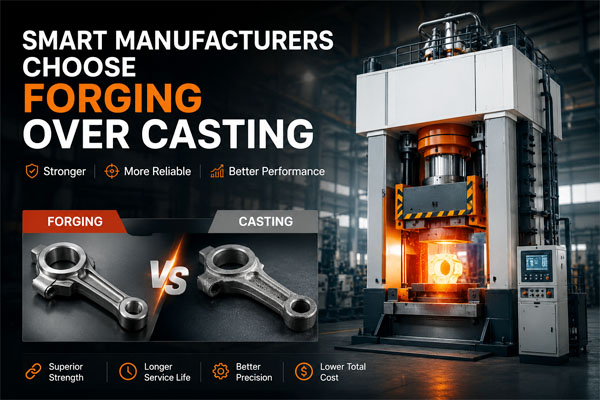
The answer is simple: Forging delivers superior strength, reliability, and long-term value.
The Grain Flow Advantage: Why Forging Creates Stronger Parts
The fundamental difference between forging and casting lies in the material's internal structure.
Casting: A Random Arrangement
When metal is melted and poured into a mold, it solidifies with a random grain structure. This process:
- Creates potential porosity (tiny air pockets)
- Produces a coarse, unpredictable grain pattern
- Cannot eliminate certain metallurgical defects
Forging: Engineered Strength
In contrast, forging shapes metal while it remains solid—forcing the material's grain structure to follow the contour of the part. This creates components that are:
- Stronger: Forging refines grain defects from cast ingots and produces a grain flow oriented in directions requiring maximum strength
- More reliable: Dendritic structures and alloy segregations are eliminated through the forging process
- More ductile: The mechanical working of the metal enhances its ability to withstand stress without fracturing
The result? Forged parts are typically 15–40% stronger than cast parts of the same material composition.
Why Casting Can't Match Forging's Strength
According to the Forging Industry Association, casting cannot obtain the strengthening effects of hot and cold working. Forging surpasses casting in predictable strength properties, producing superior strength that is assured, part to part.
Key limitations of casting include:
| Casting Limitation | Why It Matters |
|---|---|
| Porosity | Internal voids can lead to unexpected failure under stress or impact |
| No directional grain flow | Strength is equal in all directions—but not optimized for any |
| Alloy segregation | Non-uniform composition leads to unpredictable heat treatment response |
| Higher inspection costs | Defects require extensive testing and quality control |
Response to Heat Treatment: A Critical Difference
Heat treatment is essential for optimizing metal properties. Here, forging offers a distinct advantage:
- Forgings respond predictably to heat treatment, offering better dimensional stability
- Castings require close control of melting and cooling because alloy segregation may occur, resulting in non-uniform heat treatment response
This means forged parts maintain their dimensional accuracy through heat treatment—critical for applications requiring tight tolerances.
Cost Efficiency: The Long-Term Perspective
While initial tooling costs for forging can be higher, smart manufacturers look at the total cost of ownership.
Material Utilization
Forging: 70–90% material utilization
Casting: 40–95% (highly process-dependent)
Volume Economics
At production volumes of 5,000+ parts per year, forging becomes significantly more cost-effective than casting.
Scrap Value
Flash material has scrap value (typically 60–80% of raw material cost).
Faster Cycles
Cycle times of 30–120 seconds per part reduce labor costs.
Reliability reduces total cost: According to the Forging Industry Association: "Forgings are more reliable, and they are manufactured without the added costs for tighter process controls and inspection that are required for casting."
Applications Where Forging Excels
Smart manufacturers choose forging when:
- Safety is paramount: Automotive components, aerospace parts, and critical machinery
- Fatigue resistance is required: Gears, connecting rods, and suspension components
- High reliability is essential: Valve bodies, fittings, and pressure vessels
- Production volumes justify the investment: Mass production of automotive, construction, and industrial parts
The Delishi/Goodsjack Advantage
With over 27 years of hydraulic press manufacturing experience, Delishi/Goodsjack provides the equipment manufacturers need to produce superior forged components.
ISO 9001:2015 CE compliant Bosch-Rexroth hydraulics
100,000+ hours of reliable operation life
Conclusion: The Smart Choice Is Clear
When critical performance, reliability, and long-term value are at stake, smart manufacturers choose forging over casting.
- Superior strength through optimized grain flow
- Enhanced reliability with fewer defects
- Better response to heat treatment
- Greater material efficiency and cost-effectiveness at volume
- Consistent, predictable mechanical properties
Forging isn't just a manufacturing process—it's an investment in quality, safety, and brand reputation.
At Delishi/Goodsjack, we're committed to providing the high-performance hydraulic press solutions that make superior forging possible. From precision servo-controlled presses to high-tonnage heavy-duty equipment, we deliver the reliability and performance that smart manufacturers demand.
Ready to upgrade your manufacturing?
Contact Delishi/Goodsjack today to discuss your forging requirements.
With over 27 years of expertise and ISO 9001:2015 certification, Delishi/Goodsjack is your trusted partner for superior hydraulic press solutions.
 +86-13509801050
 E-mail
